Every organization wants AI that can safely utilize its data. Few can get there on their legacy estates. Velotix Atlas V3 closes that gap by turning the database migration into the moment a new kind of data security platform is built.
Velotix Atlas V3: the Innovative DSP
Organizations hold decades of valuable information across legacy databases and applications. Fragmented data structures and business logic embedded in legacy code make this information difficult to maintain, improve, and use effectively across the organization. Velotix Atlas V3 addresses this challenge by consolidating data from these systems into a unified, governed foundation that preserves business context and access policies. Before any user is let in, Atlas verifies that the same people see the same data on the new platform, and any privilege expansion blocks cutover. This consolidation is the first step in building an innovative Data Security Platform (DSP), enabling organizations to improve data quality, streamline ongoing maintenance, and apply modern tools to their business and operational needs, including analytics, automation, and AI applications such as large language models (LLMs). By an innovative DSP, I mean a platform where every data asset carries its business meaning, its access policy and its verification history, so people and AI can use it safely within their permissions.
The challenge: converting legacy databases and code
Many banks and insurers hold decades of information across databases, legacy applications, and file systems. These environments may combine Oracle, SQL Server, MySQL, and Db2 databases with applications written in COBOL or RPG and data stored in VSAM files. Consolidating them requires understanding how data is structured, how applications use it, and which controls govern access.
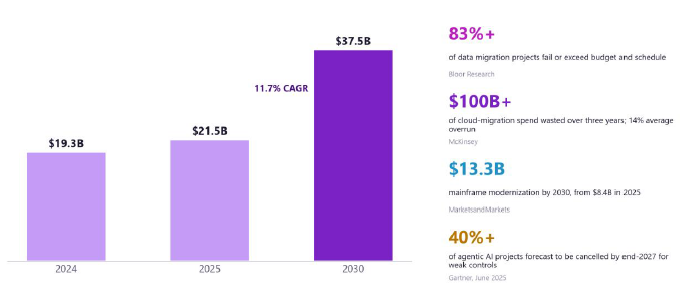
The principal challenges are:
- Fragmented structures and hidden dependencies. Inconsistent schemas, undocumented relationships, and batch processes make it difficult to establish a coherent view of organizational data.
- Business logic embedded in code. Stored procedures and legacy applications contain definitions, calculations, and business rules that must be understood and preserved during consolidation.
- Access controls across systems. Database grants, row restrictions, masking, and platform permissions must be translated into consistent policies without introducing unintended access or disrupting legitimate work.
- Data quality and verifiable integrity. Missing, inconsistent, or duplicated data must be identified. Validation must examine values and relationships alongside record counts, with traceable evidence of what was transferred, transformed, and verified.
Successful consolidation establishes a documented, governed data foundation that the organization can maintain, improve, and use as its business needs evolve. Migration and code conversion support this objective, creating the conditions for effective data management and broader use of modern tools for operations, analytics, automation, and AI.
The solution: Velotix Atlas – V3, an agent-based machine
Data consolidation and governance with Velotix Atlas
Atlas coordinates specialized AI agents through an Orchestrator that manages the consolidation workflow, including migration, code conversion, and validation. The agents share a knowledge graph and operate through typed tools with least privilege access. Each stage must pass deterministic checks and receive approval from a designated reviewer.
Discovery maps schemas, legacy code, jobs, dependencies, users, and permissions. The Velotix classifier identifies sensitive information, including personal, health, and payment card data.
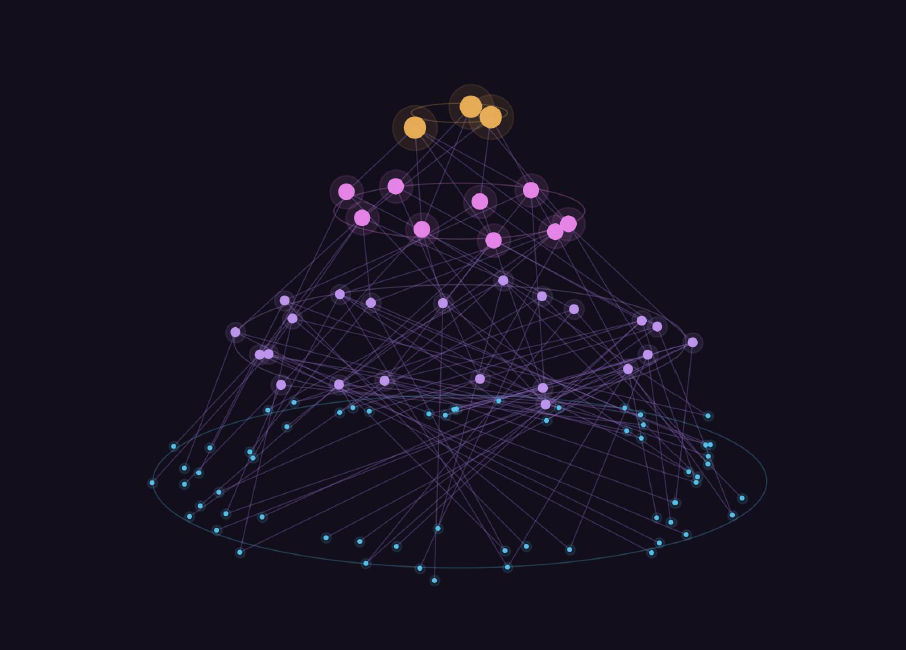
The Ontology Miner organizes this inventory into a knowledge graph with four layers: physical assets, business meaning, migration decisions, and provenance. A field such as CARDDATA.PAN is connected to its meaning as a card number, its relationships with customers and accounts, and the policies governing its use. These connections help preserve the context needed to interpret and use consolidated data correctly.
The Code Converter and Test Generator convert stored code, batch jobs, and application logic. Differential testing compares the original and converted code on the same inputs to check that expected behavior is preserved for the tested cases.
The Data Mover consolidates data on PostgreSQL and uses change data capture to replicate ongoing source updates during the transition, helping reduce operational disruption.
The Access Governor translates legacy grants, row restrictions, and masking rules into policies that data owners review and confirm. It implements these policies across the target database, BI layer, and AI assistant. Access parity checks assess whether authorized access has been preserved, and any detected privilege expansion blocks cutover.
The Reconciler validates the transferred data at five levels, including comparisons using keyed hashes of individual rows. It records verification evidence in a hash-chained ledger that supports independent audit and traceability.
The Knowledge Assistant provides natural language access through governed GraphRAG, supporting questions in Hebrew, English, Arabic, and Russian. Policies determine what each user or authorized agent may retrieve before retrieval takes place, and answers include references to their sources.
The AI components can run on open-weight models hosted on the customer’s own GPUs, with an air-gapped deployment option.
Atlas establishes the foundation for an innovative DSP by bringing legacy data, business context, and access controls into a consolidated, governed environment. This foundation supports ongoing data maintenance and quality improvement, enabling organizations to use modern tools for everyday operations, analytics, automation, and AI.
Most migrations end with a new database. With Atlas, they end with a foundation.